The hotel digital marketing landscape has evolved far beyond just making an appearance – now it’s about being there at the right time, in the right place, and with the right message. We’re talking millions of active users, advanced audience targeting and real results for hotels here.
But when it comes to comparing Google Ads vs Meta Ads for hotels, one question does come up again and again: “which one is better?”
The thing is, each platform serves a different purpose within the hotel advertising mix. Google captures people who really want to book a hotel, while Meta zeroes in on travellers through interest-based targeting and visual storytelling right across Facebook and Instagram feeds. Getting to grips with how these platforms work together will allow hotels to make better use of their ad spend and get more online visibility.
Ad Platforms Overview
Google Ads: Grabbing Demand at the Right Moment
Google Ads is a pay-per-click (PPC) system that shows search ads to people actively searching for hotels or travel experiences. If someone types in “beachfront hotels in Sydney” or “boutique hotels near Melbourne CBD”, Google will display your ad right in the search results and put your brand in front of people who are ready to book.
This makes Google Ads campaigns perfect for travellers who are serious about booking and lead generation. Hotels can reach further across Google’s partner websites through the Display Network too – promoting offers, packages, or seasonal deals on sites where travel and lifestyle are relevant.
Google’s big advantage lies in its ability to catch people who are really keen on booking – those at the stage of checking out options, reading reviews, and ready to take action.
Meta Ads: Building Awareness & Creating an Emotional Connection
Meta Ads, covering Facebook and Instagram, are all about telling a story and making an emotional connection with people. These social ads pop up Facebook and Instagram feeds, Stories, Reels, and other spots – all tailored to hit audiences who might be interested.
Instead of targeting people who are searching, Meta targets potential customers who fit your ideal guest profile. You can use lookalike audiences to reach people similar to your past guests or loyal followers, creating a natural flow of discovery and engagement.
Meta really excels at building brand awareness, getting interest through video ads and turning followers into future guests. For hotels who are big on brand storytelling, social engagement and repeat customers, Meta is a cost-effective visual channel that’s worth using.
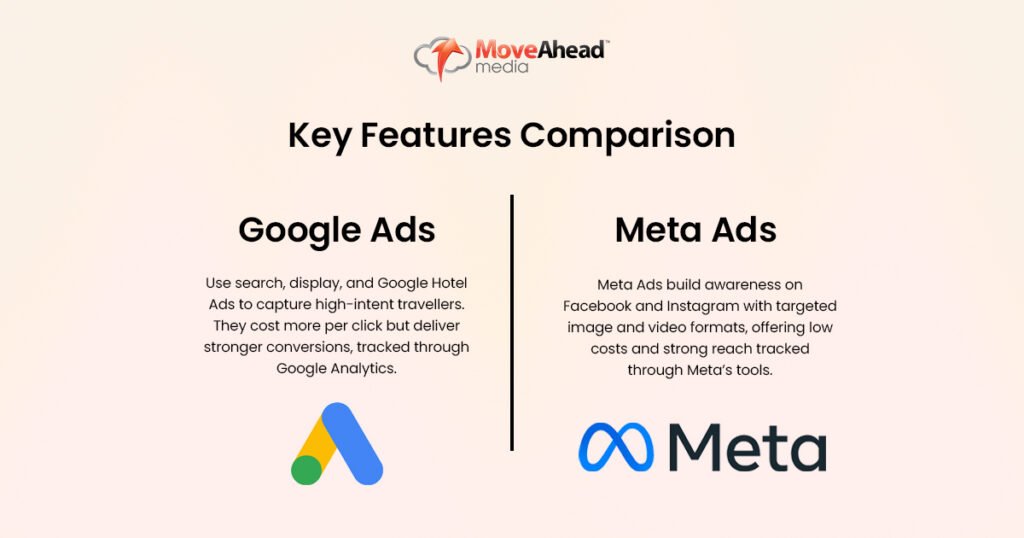
Key Features Comparison
Both Google and Meta have impressive advertising systems, but they work differently. Below is a breakdown of their key features and what makes them valuable for hotels.
Feature | Google Ads | Meta Ads (Facebook & Instagram) |
Ad Type | Text-based search ads, display ads, and Google Hotel Ads | Image and video ads, carousels, Stories, and Reels |
Targeting Method | Search intent and keywords | Interest-based targeting, behaviours, demographics |
Primary Goal | Capture high-intent users searching for hotels | Build brand awareness and engage new audiences |
Placement | Google Search, YouTube, and partner sites | Facebook and Instagram feeds, Stories, Reels |
Ad Spend Efficiency | Higher cost per click but stronger conversions | Lower cost per impression, better for reach and awareness |
Analytics Tools | Google Analytics, Conversion Tracking | Meta Business Suite, Ad Manager Insights |
Google Ads vs Meta Ads for Hotels
When hotels compare Google Ads vs Meta Ads, it’s not about choosing one over the other – it’s about working out how to use each one in the right way.
Google Ads targets people who are actively searching for hotel-related keywords. It reaches people who are ready to book, just about. These are guests who might click, compare, and book within minutes.
Meta Ads, on the other hand, reach a much wider audience who might not be planning a trip yet but are open to ideas. A well-designed video ad or carousel showcasing your rooms, views and facilities can create desire that leads to bookings later.
For instance, a luxury hotel might use Meta Ads to show off some scenic drone footage and then use Google Ads to target people searching for “best beachfront hotels in Australia.”
Getting both platforms working for you lets you control both ends of the marketing funnel – Meta for awareness and Google for conversion.
Reaching the Right Audience
Audience Targeting in Google AdsGoogle relies on keywords & search intent – hotels can target in-market travellers searching for terms like “family-friendly hotels in Perth” or “weekend escape for couples.” This is a direct, measurable & effective way to generatte bookings.
The Google Ads platform includes audience layers like geographic targeting, device segmentation & remarketing lists, so hoteliers can refine their campaigns to target users searching for specific things, at a specific time.
Audience Targeting in Meta Ads
Meta Ads reach people based on how they live their lives & what they’re into. If someone is interested in travel – or is following destination pages & interacting with other hotel brands – then Meta’s audience targeting will make sure your ads show up in their feeds, stories & your website.
Hotels can create custom audiences from lists of people who’ve emailed you, visited your website or followed you on social media – perfect for retargeting those who showed interest but didn’t book.
Together, both systems enable hotels to reach users at every stage – from curious to booking.
Real Results & ROI
Both ad platforms can deliver some truly impressive results for hotels, but their RoI comes from different things.
Google Ads RoI
Google Ads campaigns tend to have a higher conversion rate because they focus on people who are actively searching for rooms, packages or deals. Every click represents someone who’s closer to booking, giving hotels measurable outcomes through google analytics & conversion tracking.
Whilst ad spend on Google may be higher per click, the value of those clicks often outweighs the cost. A well written search ad with an optimised landing page can directly affect direct bookings & revenue growth.
Meta Ads RoI
Meta Ads tend to deliver results over a slightly longer period. They’re exceptional at building brand awareness & creating a connection between the guest & your property. By using video ads to showcase your hotel experience, you can boost social proof, engagement & long-term loyalty.
CPC (cost per click ) is usually lower, which means you can get your brand noticed even with a smaller marketing budget. It’s the real impact that shows up – in increased brand recall, returning website visits, & improved conversion rates when you pair it with Google Ads remarketing campaigns.
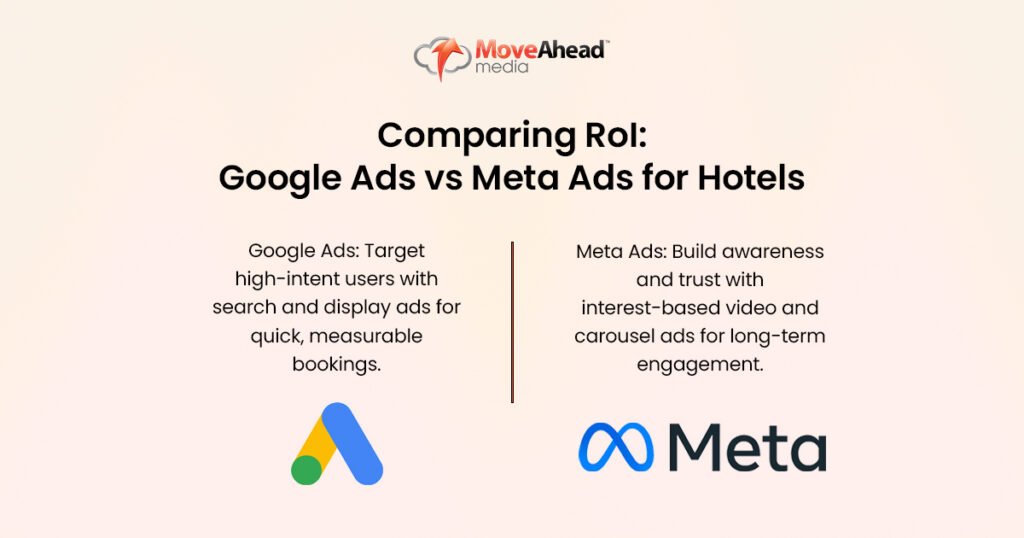
Comparing RoI: Google Ads vs Meta Ads for Hotels
| Performance Factor | Google Ads | Meta Ads |
| User Intent | Strong search intent and keyword targeting | Interest-based targeting and brand discovery |
| Conversion Speed | Quick — users are ready to book | Slower — builds trust over time |
| Average CPC | Higher, depending on competition | Lower — better for awareness campaigns |
| Ad Formats | Search ads, Hotel Ads, Display | Video ads, Reels, Carousels |
| ROI Type | Immediate bookings and measurable conversions | Long-term engagement and loyalty growth |
The most successful hotels balance both out – using Meta to get interest & Google to close the deal.
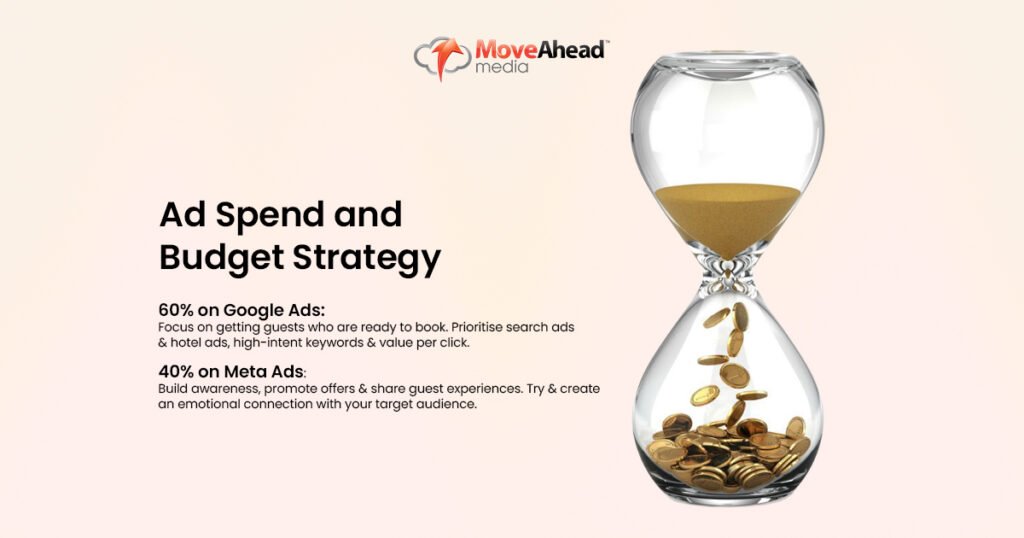
Ad Spend and Budget Strategy
Lots of hotels struggle to decide how to split their ad spend effectively. Here’s a pretty balanced approach that works for most small businesses & boutique hotels:
- 60% on Google Ads: Focus on search ads & hotel ads to get guests who are ready to book. Prioritise high-intent keywords to make sure you get value per click.
- 40% on Meta Ads: Use social ads to get people talking, promote offers & share guest experiences that build an emotional connection.
Test, analyse & refine each month. Use google analytics & Meta Business suite to track which ad formats deliver the best RoI.
The secret is to use both together – not try to compete them against each other.
Common Challenges When Comparing Options
Deciding between Google Ads vs Meta Ads can be a bit overwhelming for hotels who are just starting out with online advertising. Both platforms have a learning curve, different targeting systems & unique creative needs.
Google Ads requires more expertise in keyword management, bidding & ad copywriting, whilst Meta Ads depends heavily on visuals, storytelling & design.
However, once you get the hang of it, each one can work for different business goals – Google for lead generation & Meta for brand building.
Hotels that put the time in to learn & test see faster growth, stronger conversion rates & a cost-effective advertising model over time.

Combining Platforms for Maximum Impact
The best results come from hotels using both platforms together.
Imagine a traveller sees your property in a Meta video ad, then later searches for your brand on Google & clicks your search ad. That’s a complete customer journey – from discovery to decision.
Use remarketing ads across platforms to stay in guests minds. Someone who watches your video on Instagram might see your Google Display ad the next day, reminding them to finalise their booking.
Ad Spend and Budget Strategy
Rather than getting bogged down in exactly how to split your ad spend, here’s a simple approach that works for most hotels:
- 60% on Google Ads: Focus on getting guests who are ready to book. Prioritise search ads & hotel ads, high-intent keywords & value per click.
- 40% on Meta Ads: Build awareness, promote offers & share guest experiences. Try & create an emotional connection with your target audience.
Test, analyse & refine each month. Use google analytics & Meta Business suite to track which ad formats work best.
The secret is to use both together – not try to compete them against each other.
Common Challenges When Comparing Options
Hotels can get a bit overwhelmed when trying to decide between Google Ads vs Meta Ads. Both platforms have a learning curve, different targeting systems & unique creative needs.
Google Ads requires more expertise in keyword management & ad copywriting, whilst Meta Ads depends on visuals, storytelling & design.
Once mastered, each can work for different business goals – Google for lead generation, Meta for brand building.
Hotels that invest in learning & testing see faster growth, stronger conversion rates & a cost-effective advertising model over time.
Combining Platforms for Maximum Impact
The best results come when you use both platforms together.
Imagine a guest sees your property in a Meta video ad, then later searches for your brand on Google & clicks your search ad. That’s a complete customer journey – from discovery to decision.
Use remarketing ads across platforms to stay in guests minds. Whoever watches your video on Instagram might see your Google Display ad the next day, reminding them to finalise their booking.
Combining Platforms for Maximum Impact
The best results come when hotels use both platforms together – Google & Meta – to create a complete customer journey.
Hotels can benchmark their progress by using a balanced approach to splitting their ad spend.
- 60% on Google Ads: Focus on people who are ready to book\
- 40% on Meta Ads: Build awareness & promote your hotel.
Test, analyse & refine each month. Hotels that use this multi-channel way of advertising see steady results right across the booking process – from people getting to know their place to them actually booking a room.
Key Takeaways
- Google Ads works a treat for people who’re already looking to book a room and want to book now.
- Meta Ads is brilliant for getting the word out and building up a long-term connection with the people who are interested in your hotel.
- When you’re splashing out on ads, it’s a good idea to think carefully about splitting your spend between grabbing people’s attention and gradually winning them over.
- Google Search results are what actually get people to book a room – and Facebook and Instagram feeds are where you get to build a relationship with people and keep them interested.
- The more channels you use, the bigger your audience is going to be and the more chances you’ve got of reaching the right people at the right time.
It’s the hotels that use targeted ads and pull people in with a good story that manage to turn browsers into loyal customers.

Final Thoughts
The real question isn’t actually “which is better – Google Ads or Meta Ads for hotels?”. What we should be asking is – how can we get the two working together to help your hotel do better?
Google Ads makes people book rooms by itself – Meta Ads makes people curious about your place and connect with your brand. One taps into demand and the other creates demand.
By using both in a clever way hotels can get more guests coming in, build a solid reputation online and make their digital marketing campaigns a long-term success.
If you want to take your campaigns to the next level or make sure you’re getting the best out of pay per click PPC then it might be worth getting in touch with some digital marketing experts for hotels who know a thing or two about blending clever targeting with creative ideas.
After all the best campaigns aren’t just about showing off your hotel – it’s about making people want to come and stay.

FAQs
What’s the fastest way to spot wasted spend?
The fastest way to spot wasted spend is to focus on two key areas: your objectives and your audience.
First, ensure you have clear, measurable objectives. Without a benchmark for success, you can’t identify underperformance.
Second, regularly audit your audience to confirm you’re targeting the right people. Even the best ads can fail if they’re shown to the wrong audience.
What’s the best way to A/B-test creative while still keeping clean data?
The best way to keep data clean is to follow the one-variable rule. Only change a single element between your “A” and “B” versions.
This could be the headline, the image, or the call-to-action, but never all three at the same time. The goal is for you to attribute any performance difference directly to that specific change.
Many marketers make the mistake of stopping their A/B tests too early. By letting your test run long enough, you’ll be able to gather more reliable results with your ad analysis tool.
What metrics actually tell me if my campaign is working?
The ‘best’ metrics depend entirely on your campaign’s primary objective. The key is to align your metrics with your goal in the marketing funnel:
- For Awareness Campaigns, focus on Reach and Impressions to measure how many unique users are seeing your ad.
- For Engagement Campaigns, track Click-Through Rate (CTR) and Cost Per Click (CPC) to measure how effectively you’re driving interest.
- For Conversion Campaigns, focus on metrics that measure direct business results, such as Cost Per Acquisition (CPA) and Return on Ad Spend (ROAS).
Overall, prioritising metrics like ROAS over simple clicks is how you can gain a better understanding of your campaign’s success. It’s what allows you to move from generic to data-driven advertising campaigns.